We Don't Just Invest in AI. We Build It — With AI.
How a governed eco-system of AI agents builds real, production software — and why our next venture is being built this way.
Most companies talking about AI are using it. We wanted to know what happens when you let AI build — not a demo, not a prototype, but a complete, production-grade product that real people will use every day.
So we did. Over the last seven months, a fleet of AI agents — coordinated, governed, and held to a strict standard of honesty — built an entire AI application end to end. It ships on December 7. We're not naming it yet. This series is about how it was built, because the method is as much the story as the product.
Two ways we build
GreenLeafSource incubates ventures two ways. The first is hands in the soil: a real-world business — land, crops, logistics — with applied AI as its technology layer. The work is physical; the AI makes it smarter.
We told that first story in From an Idea to 12,000 Trees: How We Built a Sustainable Date Farm.
The second is what this series is about: agentic. Here the product itself is AI — and so is the workforce that builds it. A governed eco-system of agents writes the code, runs the tests, keeps the memory, and ships the releases, all on a written constitution and under human governance.
One venture is grown. The other is, in a sense, self‑built.
The Agentic Method
It's tempting to picture "AI building software" as one clever model typing code. That isn't what this is. What we built behaves less like a tool and more like an organization — specialized agents with roles, rules, a shared memory, and a chain of accountability. Five components, wrapped in human governance.
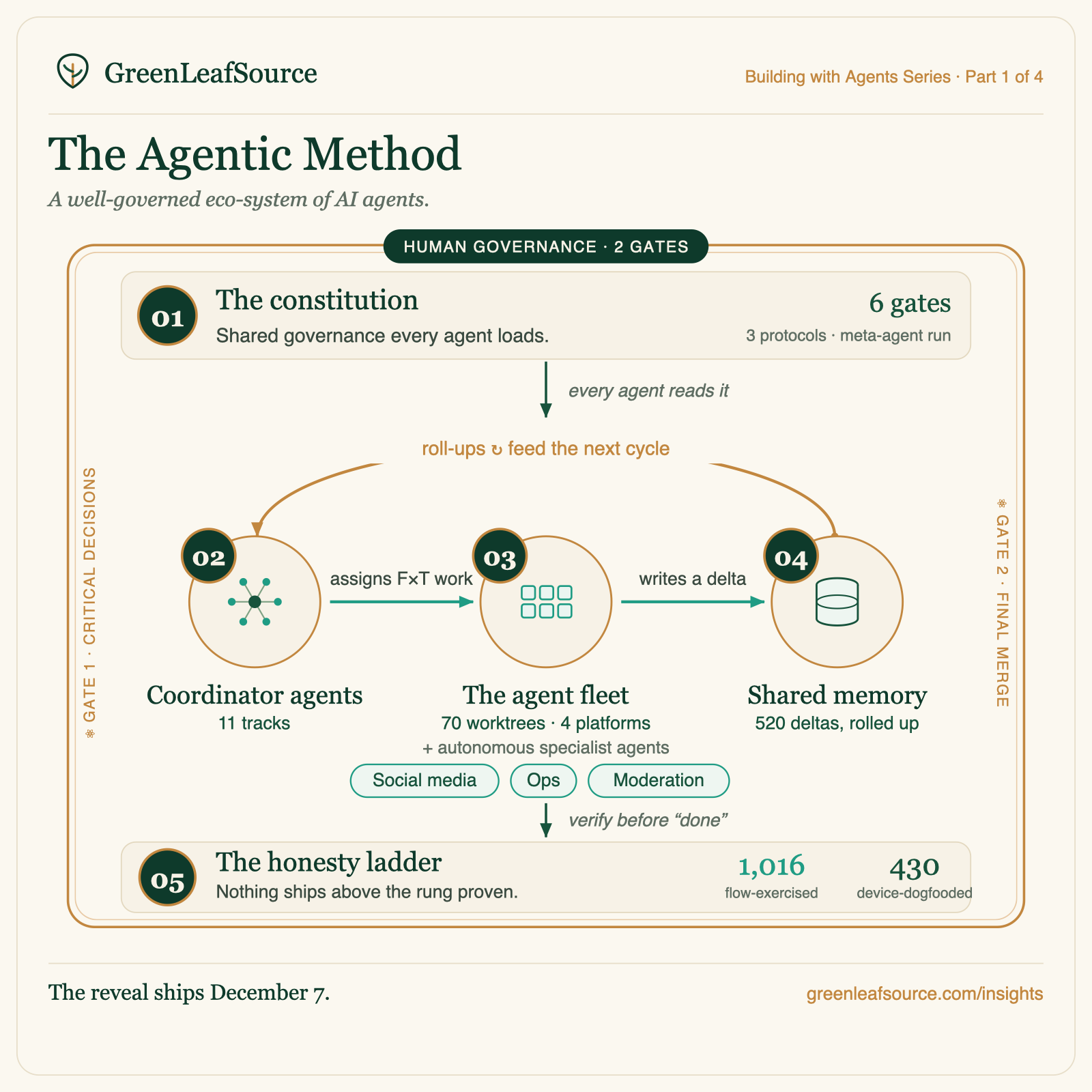
01 · The constitution. Before any agent does anything, it loads a single written contract that defines how work is done, how decisions are logged, and what "done" is allowed to mean. No improvising. The contract itself is maintained by dedicated meta agents, so the rules evolve deliberately rather than drift.
- Don't assume — confirm the mandate. If the objective isn't explicit, the agent must stop and have a person clarify the scope. Guessing and pressing ahead is not allowed.
- Nothing is reported as finished until it's proven. Every status is tied to the level of checking behind it — partial progress is never presented as a completed result.
- High-stakes decisions pause for a person. Anything costly or hard to reverse — customer data, privacy, security, or commitments other teams will depend on — needs explicit human sign-off before any work starts.
- Every action is on the record, and nothing goes live without approval. Leaving work undocumented is treated as a violation, with no exceptions — and no result reaches the public until a person has reviewed and approved it.
02 · Coordinator agents. Work is mapped onto a coordinate system — eleven parallel tracks, each a slice of the product — and coordinator agents assign and route it. Nothing is ad hoc; every task has an address.
03 · The agent fleet. Specialist agents then execute in parallel, each in its own isolated workspace, across four different AI platforms. Alongside the engineering agents run autonomous specialists — a social-media agent, an operations agent, a moderation agent. The fleet is a workforce, not a single worker.
04 · Shared memory. This is the part that makes agents trustworthy at scale. Every session ends by writing a structured delta — what it touched, what it decided, what the next agent should do. Roll-up agents periodically fold the deltas into versioned master documents, so the next agent starts with every lesson the last one learned.
Over the build, the fleet wrote 520 session deltas — roughly 21,820 lines of institutional memory. That's why agent number seventy starts as informed as agent number one. Coordinator → fleet → memory → back to the coordinator: a loop that gets smarter each turn.
05 · The honesty ladder. The hardest problem with autonomous software isn't capability — it's truth. So every claim of progress is pinned to a rung: compiles → target-attached → flow-exercised → device-dogfooded. Nothing is called finished above the rung actually proven.
A build is not a behavior. An agent may not call something done because the code compiles — only because the behavior was proven at the level it claims. It's the discipline that lets a fleet of agents move fast and be trusted.
Governed by humans, at two gates
Autonomy without governance is just risk. The whole eco-system sits inside a human safety net with exactly two gates: the costly, hard-to-reverse decisions, and the final merge. Everything in between, the agents own. The humans don't do the work — they decide what's allowed to become real.
A well-run agentic eco-system isn't about removing people — it's about putting them where they matter most. Rules, memory, honest accounting, and two human gates are what turn raw autonomy into something you'd actually ship.
Our next venture — an AI tool for everyday life — ships December 7.
This is Part 1 of four. Part 2 — from idea to blueprint — shows how a vague product becomes an addressable plan the agents can build. Part 3 covers the hard parts: a model bake-off decided on evidence, an agent that caught its own mistake, and the day we pulled an autonomous agent back. Part 4 is the reveal — a few days after launch, the method and the product it built, together, in a release from our founder.
We've spent years learning to grow things with care. It turns out the same discipline is exactly what it takes to build with agents.
Follow the series →Figures are from GreenLeafSource's own build, measured November 2026, and describe the method — not the product.